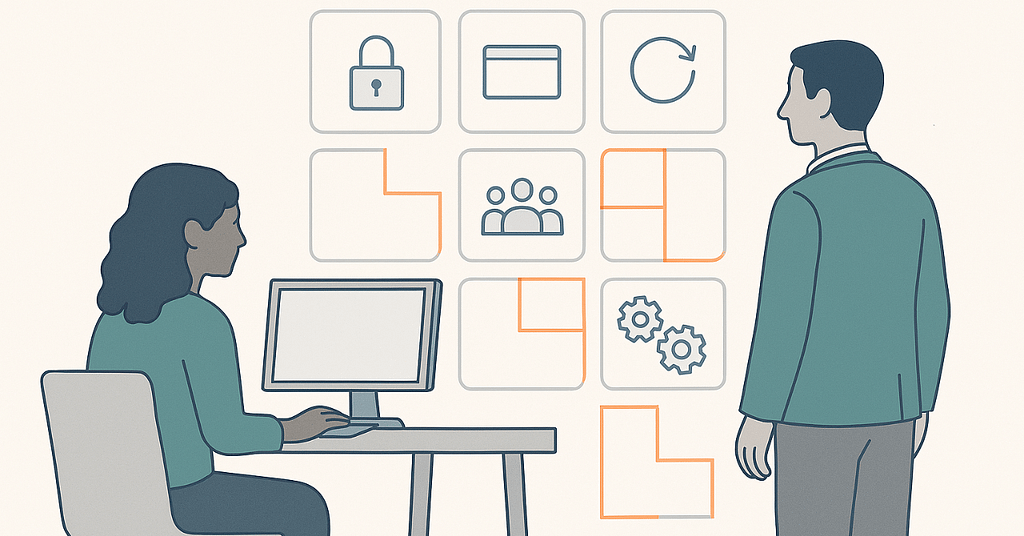
Most SMB leaders don’t ignore cybersecurity — they delegate it.
And that delegation often turns security into a collection of tools, tasks, and reminders rather than a system with clear priorities and ownership. The result isn’t negligence, but misalignment: effort without structure, protection without consistency.
That disconnect is why many cybersecurity failures feel surprising in hindsight, even though the warning signs were there all along.
For small and mid-sized businesses, cybersecurity risk usually builds through everyday decisions that seem reasonable at the time — especially with limited staff, tight budgets, and competing priorities.
Meanwhile, attackers have become faster and more automated. According to the Verizon Data Breach Investigations Report, credential theft, phishing, and exploited vulnerabilities now dominate how breaches begin — and SMBs are frequently targeted because defenses are inconsistent, not nonexistent.
Below are the 10 most common cybersecurity mistakes SMBs make, why they happen, and what fixing them the right way looks like from a business-first perspective.
Table of Contents
1. Treating Cybersecurity as an IT Task Instead of a Business Risk
Many businesses leave cybersecurity entirely to IT, which often means leadership isn’t actively involved in risk decisions. Without clear ownership, priorities shift, decisions slow down, and security efforts become inconsistent.
The National Institute of Standards and Technology (NIST) emphasizes that cybersecurity is an enterprise risk — similar to financial or operational risk — and should be reviewed regularly by leadership. When leaders set expectations and direction, security decisions become clearer and more aligned with business goals.
2. Underestimating Identity Risk and Delaying Multi-Factor Protection
Stolen login credentials remain one of the most common ways attackers gain access, yet many SMBs still rely on passwords alone. This puts email, remote access, and cloud tools at unnecessary risk.

The Cybersecurity and Infrastructure Security Agency (CISA) lists multi-factor authentication as one of the most effective and accessible protections for small businesses. Adding a second verification step dramatically reduces unauthorized access without major disruption.
3. Letting Software and Systems Go Unpatched
Outdated software continues to be a leading cause of cyber incidents because attackers quickly exploit known weaknesses. Many businesses delay updates due to fear of downtime or unclear responsibility.
It’s crucial to prioritize updates for the most exposed systems and maintain a predictable update schedule. Staying reasonably current matters far more than being perfect.
4. Treating Security Awareness as a Once-a-Year Activity
Annual training sessions don’t prepare employees for the constant stream of phishing emails and scam messages they face. The Federal Trade Commission (FTC) stresses that ongoing awareness and simple reporting habits are far more effective than one-time instruction.
When employees know what to watch for and how to report concerns quickly, incidents are caught sooner and cause less damage.
5. Assuming Backups Are Reliable Without Testing Them
Many businesses believe they’re protected because backups exist — but they’ve never tested whether those backups can actually be restored. In ransomware incidents, backups that are connected to live systems are often targeted first.
Isolating backups and routinely testing recovery are highly encouraged, so downtime is predictable instead of chaotic. A backup that hasn’t been tested is a risk, not a safeguard.
6. Lacking a Clear Incident Response Plan
When a cyber incident occurs, confusion costs time and money. Without a documented plan, teams struggle to decide who should act, what steps to take, and how to communicate.

Even small businesses have to maintain a simple, practiced response plan so actions are coordinated instead of reactive. Preparation turns high-stress moments into manageable situations.
7. Losing Visibility Over Apps and Tools in Use
Employees often adopt new software to stay productive, but unmanaged tools can create blind spots for data access and security. Over time, information spreads across systems no one fully tracks.
Businesses should maintain visibility into approved tools and control access through centralized accounts. Knowing what’s in use is the foundation of protecting it.
8. Assuming Security Tools Work Without Oversight
Installing security software is important, but tools alone don’t stop threats. Alerts need to be monitored, investigated, and acted on in real time. CISA highlights the importance of pairing technology with clear responsibility, so warnings lead to action, not silence. Security improves when there’s consistent attention, not just installed software.
9. Overlooking Risks Introduced by Vendors and Partners
Many SMBs share data or system access with vendors yet rarely verify how those partners protect information. If a third party is compromised, your business may still suffer the consequences. Hence, identifying which vendors are critical and setting minimum security expectations are essential. Trust matters — but visibility and accountability matter more.
10. Ignoring Legal and Reporting Responsibilities
Cyber incidents often come with legal and reporting obligations, especially when customer or employee data is involved. Many businesses only consider these requirements after an incident occurs. The FTC outlines clear expectations for protecting data and responding appropriately to breaches. Preparing in advance helps businesses act responsibly and avoid unnecessary penalties or reputational damage.
What This Means for SMB Leaders
Most cybersecurity mistakes SMBs make aren’t caused by neglect.
They’re caused by lack of structure.
Cybersecurity works best when it’s treated as an ongoing business system — one with ownership, priorities, testing, and visibility. The strongest security programs don’t rely on fear or complexity. They rely on clarity, consistency, and intentional decisions that reflect how the business actually operates.
A good next step isn’t buying another tool.
It’s understanding where risk truly lives in your environment — and whether your current approach matches that reality.

Frequently Asked Questions
1. What is the biggest cybersecurity risk for SMBs today?
Credential theft combined with weak identity controls remains the most common entry point.
2. How often should SMBs test backups?
At least quarterly for critical systems, with documented RTO/RPO.
3. Is MFA really necessary for small businesses?
Yes — especially for email, remote access, and admin accounts. It’s now baseline, not advanced.
4. Do SMBs need a formal incident response plan?
Yes. Even a one-page plan dramatically improves response speed and outcomes.
5. How does managed IT help with cybersecurity?
By providing structure: governance, monitoring, prioritization, and accountability — not just tools.