Most organizations delay replacing hardware until it’s necessary—a workstation slows down, a server shows errors, or an imaging system seems adequate for another year.
In a stable market, that approach often works.
In a constrained hardware market, it quietly increases risk.
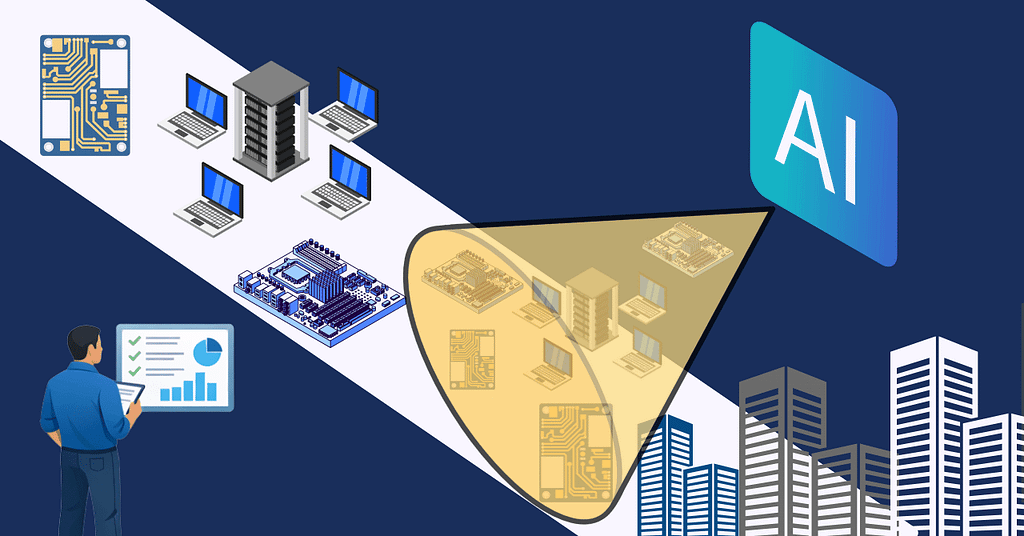
A major driver behind today’s constraints is the rapid expansion of AI infrastructure. Large-scale AI systems require significantly more memory and storage than traditional workloads.
To meet that demand, major manufacturers have shifted production capacity toward data-center components — tightening availability and raising prices for the same memory and storage used in everyday workstations, servers, and imaging systems.
This isn’t a short-term disruption. It’s a structural shift in how core hardware components are allocated. And it changes what “waiting” actually costs.
Table of Contents
Why Waiting Carries More Risk Than It Used To
When hardware supply was predictable, waiting until systems reached end-of-life was usually manageable. In today’s market, AI-driven demand has reduced slack across the supply chain — leaving far less room for reactive decisions.
The impact shows up in a few consistent ways.
Reactive Replacements Become More Likely
When a workstation, server, or imaging system fails unexpectedly, limited component availability can force organizations into reactive replacements.
Instead of selecting systems that align with:
- performance requirements
- regulatory or compliance needs
- long-term support lifecycles
Teams are often left choosing from what’s immediately available — not what’s best suited for the environment.
AI-driven memory and storage demand means those “last-minute” options are increasingly constrained.
Fewer Configuration Options
To manage limited supply, manufacturers have tightened quoting practices and reduced configuration flexibility. In some cases, contract pricing has been paused, and certain memory lines have seen temporary quoting freezes.
As a result:
- approved configurations are narrowing
- standardization becomes harder
- long-term planning gives way to short-term compromise
When configuration choice shrinks, organizations lose control — not just over price, but over system longevity and fit.
Operational and Financial Impact Compounds
Unplanned downtime is costly on its own. In a constrained market, it often coincides with elevated pricing and longer lead times.
Analysts continue to project sustained pricing pressure into 2028 and beyond, driven in large part by ongoing AI infrastructure expansion. When failures collide with supply constraints, organizations absorb both operational disruption and financial strain at the same time.
What Intentional Planning Looks Like Right Now
The organizations navigating this market best aren’t buying more hardware.
They’re planning better.
Intentional hardware planning shifts the model from “wait until it breaks” to “prepare before the market dictates your options.”
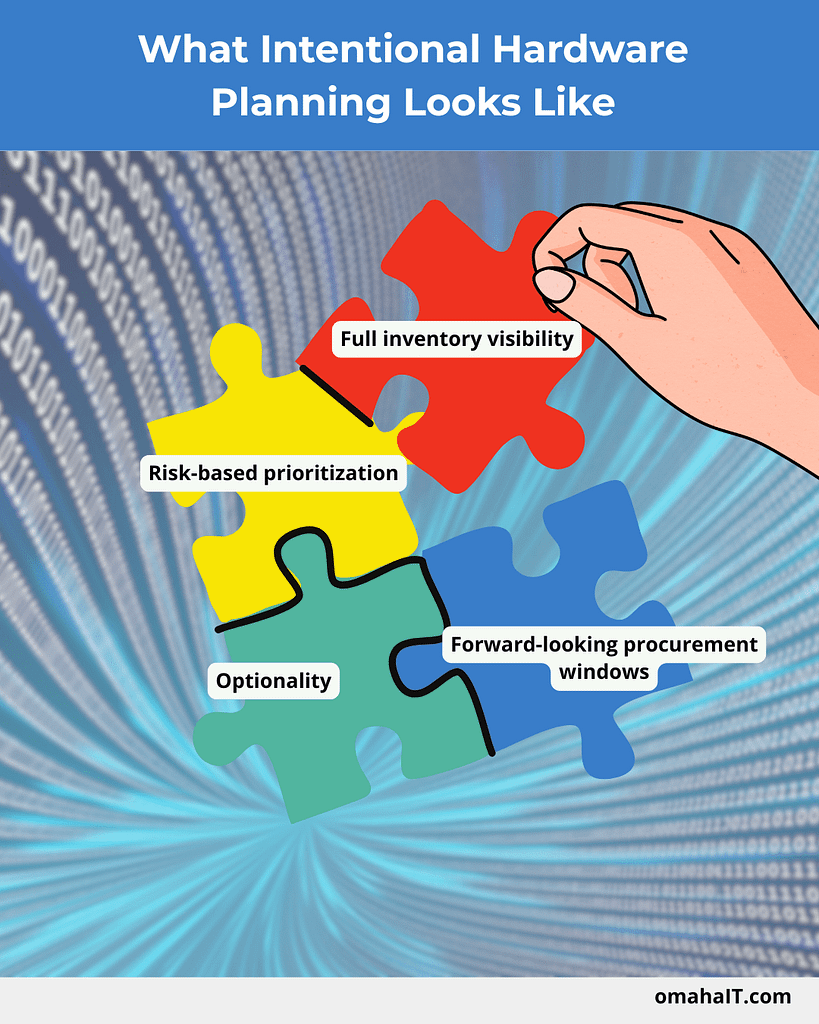
A modern planning approach includes:
- Full inventory visibility: Clear insight into all workstations, servers, imaging units, and network components — including age, role, and performance.
- Risk-based prioritization: Identifying aging or at-risk systems based on business impact, manufacturer lifecycle stages, and operational dependency.
- Optionality: Pre-identifying multiple viable configurations or supply paths instead of relying on a single model or vendor.
- Forward-looking procurement windows: Understanding realistic lead times and planning windows — without committing to immediate purchases.
This kind of visibility preserves choice in a market where choice is increasingly limited.
How Leaders Can Reduce Surprise (Without Making Reactive Purchases)
The most effective step leaders can take right now doesn’t involve buying anything.
It involves clarity.
Reducing surprise in a constrained hardware market typically starts with:
- early forecasting conversations with trusted technology partners
- mapping multi-year refresh expectations instead of single-event replacements
- understanding upcoming manufacturer milestones, such as end-of-support or model retirements
- pre-evaluating compatible system alternatives to avoid last-minute decisions
None of this requires action today. The goal is to remove uncertainty in a market where uncertainty has become common.
Industry-Specific Considerations
Healthcare & Dental
Clinical environments rely heavily on imaging performance, which is closely tied to GPU and SSD availability — both of which are under pressure from AI-driven data center demand.
Planning ahead helps ensure clinical workflows aren’t slowed by outdated or underpowered systems.
Relevant environments include:
Dental imaging rooms, CBCT systems, intraoral cameras, ultrasound, and radiography workstations.
Veterinary Practices
Many veterinary clinics operate with mixed-age hardware across front desk, diagnostic, and clinical systems.
In a constrained market, reactive replacements often disrupt workflows and strain budgets. Proactive lifecycle planning helps stabilize costs and reduce operational interruptions.
Professional Services (Legal, Finance, Real Estate, SMB)
Frequent multitasking and heavy software usage place consistent demands on workstation memory and storage.
DRAM constraints and pricing volatility directly affect the everyday productivity machines these organizations rely on — making forward planning critical to maintaining performance and predictability.
Final Thought
Waiting isn’t neutral anymore. In a constrained hardware market, it quietly limits options, increases exposure to downtime, and shifts control from leadership to circumstance. Planning restores that control.
