
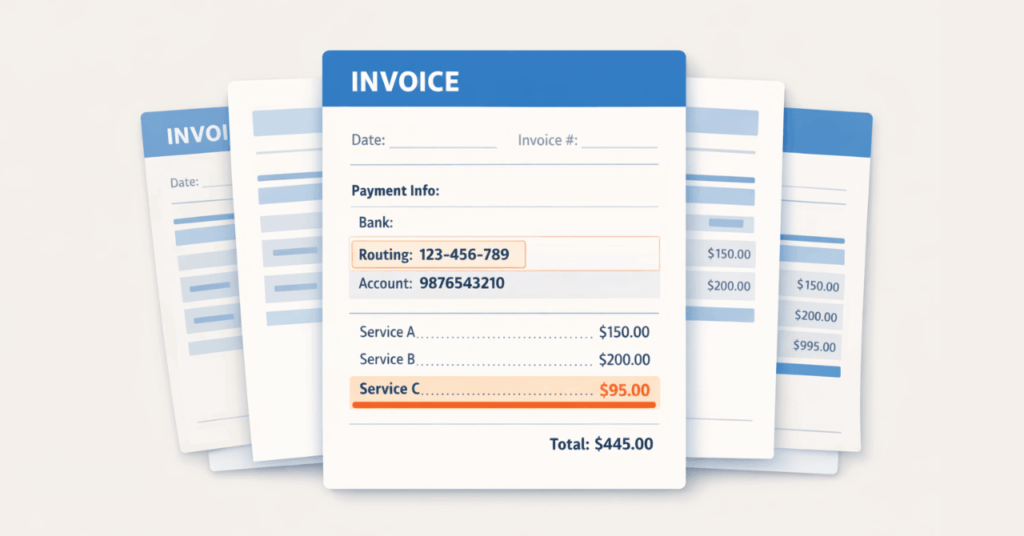
Most invoice fraud goes unnoticed at first, as it blends in with regular business activities. Invoices arrive, vendors ask for updates, and payments are prepared to meet deadlines. Sometimes, someone urgently requests a bank detail change to process an order on time; these situations should be reviewed carefully as they may signal invoice fraud risk.
This article breaks down why resellers are prime targets for invoice fraud, how modern attacks actually work, and what practical, evidence-based controls reduce risk without slowing the business down.
How Invoice Fraud Actually Works in Reseller Environments
Look-Alike Domains and Supplier Impersonation

Attackers frequently register domains that differ by a single character from a real supplier’s email address. In some cases, they clone the supplier’s website and email signature entirely.
To a busy AP team, everything looks right — because it’s designed to.
Intercepted Invoices with Altered Payment Details
In many cases, the invoice itself is legitimate. The payment details are not.
After compromising a vendor’s email account, attackers modify invoices before forwarding them along. Same amounts. Same branding. Different bank account.
This is one of the most common invoice fraud patterns today — and one of the hardest to catch without process controls.
Phantom Vendors and Low-Dollar Invoices
Some fraud doesn’t target large payments at all.
Attackers create realistic but fake vendors and submit smaller invoices designed to slide under escalation thresholds. Over time, these add up — and often go undetected for months.

Social Engineering: Urgency Beats Accuracy
Fraudsters lean heavily on urgency and authority:
- “We need this processed today.”
- “The account changed due to an audit.”
- “This is holding up shipment.”
When speed matters operationally, pressure works.
How Businesses Reduce Invoice Fraud Risk (Without Slowing Down)
The most effective defenses aren’t flashy tools. They’re intentional controls that match how work actually gets done.
Strengthen Vendor Verification — Outside Email
Critical payment changes should always be verified through a second channel:
- Phone confirmation using known contacts
- Pre-approved banking details
- Multi-person approval for changes
Email alone should NEVER be the source of truth.
Add Payment Controls and Anomaly Monitoring
Modern payment systems can flag unusual changes — new accounts, timing shifts, or mismatches between invoice history and behavior.
These controls catch problems early, when fixes are still easy.
Lock Down Email with Proper Authentication
Domain spoofing is a primary delivery method for invoice fraud. Enforcing DMARC, SPF, and DKIM dramatically reduces successful impersonation attempts.
This is foundational, not optional.
Reduce the Impact of Account Compromise
Because many attacks use real accounts:
- Multi-factor authentication
- Privileged access controls
- Continuous login monitoring
…are essential for limiting damage when something slips through.
Train Staff for Reality — Not Theory

Training should focus on what people actually see:
- Urgent payment changes
- Slight domain variations
- New vendor requests
- Authority pressure
Human judgment is one of the strongest defenses — when it’s supported, not blamed.
Automate Invoice Matching Where Possible
Automated matching between purchase orders, receipts, and invoices catches duplicates and phantom invoices early, especially in high-volume environments.
What This Means for Leadership
Invoice fraud risk isn’t a technology problem. It’s a workflow problem.
Resellers are targeted because their operations depend on trust, speed, and email — not because they’re doing something wrong. The businesses that reduce risk don’t slow everything down. They introduce clarity where assumptions used to live.
If you want clarity on where invoice fraud risk actually lives in your environment — and which controls would reduce exposure without disrupting operations — a focused review can surface that quickly.

Frequently Asked Questions
1. Why is invoice fraud risk higher for resellers than other businesses?
Resellers process high volumes of vendor payments, rely on complex supply chains, and operate on tight timelines — conditions that allow fraud to blend into daily operations.
2. Is invoice fraud a technical attack or a human one?
Most invoice fraud exploits trust and workflow gaps, not system vulnerabilities. Email impersonation and social engineering are the primary tools.
3. What’s the single most effective prevention step?
Out-of-band verification for payment changes. Email should never be the only confirmation method.
4. Does email security really matter if staff are trained?
Yes. Training helps people spot issues, but authentication controls stop many attacks before humans ever see them.
5. How quickly can these controls be implemented?
Many foundational controls — MFA, email authentication, approval workflows — can be implemented in weeks, not months.