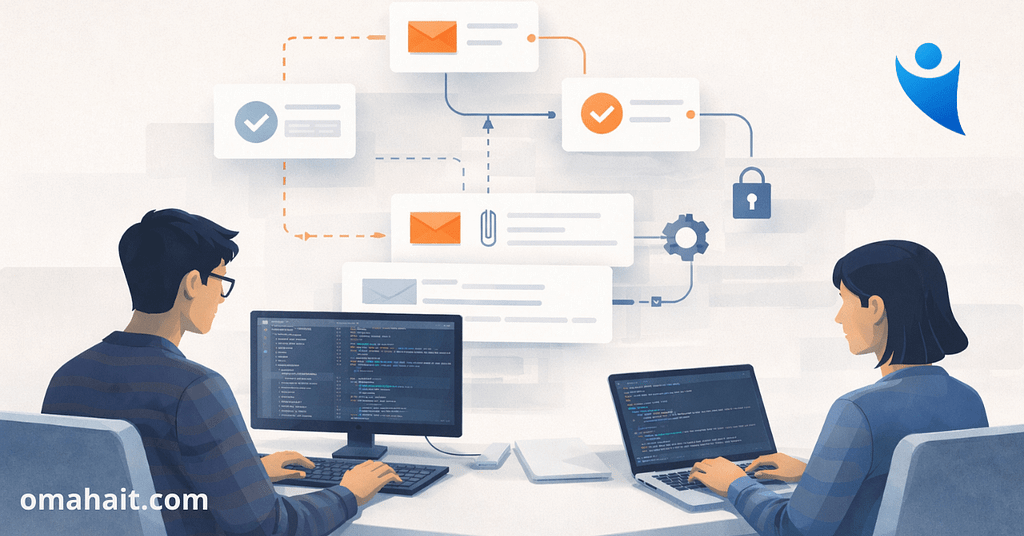
Email Fraud in Professional Services: What Firms Miss
Email is where professional firms make real decisions.
Payments are approved. Client instructions are confirmed. Vendors are paid. Sensitive documents move forward.
Most of this happens quickly, informally, and without much friction — because that’s how professional services stay efficient and responsive.
That same efficiency is what makes email fraud in professional services so effective.
Not because firms are careless.
But because their workflows depend on trust, familiarity, and momentum.
Table of Contents
Why email fraud works so well in professional firms
Professional services firms share operational traits that attackers deliberately look for.
Email drives authority, not just communication
In many firms, email isn’t a notification layer — it is the approval layer.
A short message from the right person can:
- Trigger a wire transfer
- Change payment details
- Approve an invoice
- Release confidential information
When email carries that level of authority, impersonation becomes powerful.
This is the foundation of business email compromise.
Trust is assumed — and rarely re-verified
Firms are built on long-standing internal and external relationships.
People recognize names, writing styles, and routines.
They’re used to requests that are brief, urgent, and informal.
Attackers don’t disrupt that pattern.
They imitate it.
That’s why fraudulent emails often feel normal — not suspicious.
Speed quietly overrides verification
Professional firms are under constant pressure to move quickly.
Clients expect responsiveness.
Leadership expects follow-through.
Staff are rewarded for keeping things moving.
Over time, verification steps get relaxed:
- “I’ll confirm later.”
- “This looks routine.”
- “I don’t want to slow this down.”
Those small decisions accumulate into systemic exposure — a core issue in professional firm cybersecurity.
What business email compromise actually looks like
There’s no dramatic warning sign.
A message arrives that appears to come from a partner or executive.
The request fits the context of current work.
The language matches how that person usually communicates.
Nothing feels off enough to stop the process.
Funds move.
Details change.
And only afterward does the firm realize what happened.
This is why email fraud in professional services is so difficult to reverse — and so disruptive.
Why tools alone don’t solve the problem
Many firms assume that adding more security software equals better protection.
Technology matters — but it doesn’t define safety.
Email fraud succeeds because:
- Authority isn’t clearly bounded
- Exceptions aren’t formally governed
- Verification depends on judgment, not structure
No tool can compensate for unclear decision ownership.
Protection requires intention, not accumulation.
The operational impact firms underestimate
Even near-misses leave a mark.
People hesitate before acting.
Leadership confidence erodes.
Processes become inconsistent.
The cost isn’t just financial — it’s operational trust.
That’s why email fraud in professional services should be addressed as a leadership and workflow issue, not a technical one.
What “protected” actually looks like in practice
Protected firms don’t rely on suspicion.
They rely on clarity.
Clear authority boundaries
Everyone knows:
- Who can approve financial actions
- Under what conditions
- With what confirmation steps
No ambiguity. No guesswork. Simply aligning IT decisions with business operations.
Intentional verification, not friction
Verification steps are:
- Standardized
- Expected
- Supported by leadership
They’re part of the workflow — not a disruption to it.
Visibility into real risk
Leadership understands:
- Where high-risk email actions occur
- How often exceptions are made
- Which accounts carry the most exposure
Visibility turns assumptions into decisions.
Training that explains why
Staff aren’t trained to fear email — they’re trained to understand it.
They learn:
- How fraud exploits routine
- What decisions attackers target
- Why certain steps exist
That understanding sustains good behavior over time.
Why leadership involvement changes everything
Email fraud doesn’t happen because someone made a bad call.
It happens because decision frameworks were unclear.
Leadership sets:
- The tone for verification
- The tolerance for exceptions
- The balance between speed and protection
When leaders model clarity, the firm follows.
A better next step than adding another tool
If you’re unsure whether your firm is truly protected, start by gaining clarity.
Understand:
- Where decisions live
- How they’re verified
- Where assumptions exist
That’s how firms reduce risk while maintaining confidence and momentum.

Frequently Asked Questions
1. What is email fraud in professional services?
Email fraud in professional services involves impersonation or manipulation through email to trigger unauthorized payments, data sharing, or workflow changes.
2. How is business email compromise different from phishing?
Business email compromise is targeted, contextual, and often uses real names and workflows. Phishing is typically broader and easier to spot.
3. Can email security tools prevent this?
They help, but they don’t address unclear authority or informal approval habits — where most risk lives.
4. Why are professional firms targeted so often?
Because email drives real decisions, trust is high, and speed is prioritized.
5. Is this an IT issue or a leadership issue?
Both — but leadership defines the decision framework that technology supports.
Email Fraud in Professional Services: What Firms Miss Read More »