Benjamin Vera Cruz

Flat-style illustration of a healthcare clinic workstation with overlapping interface panels on screen, suggesting shared access and system ambiguity—visually supporting the concept of hidden IT risks in clinics with shared devices.

Hidden IT Risks in Clinics with Shared Devices

Most clinics don’t operate in quiet, controlled office environments.

In community clinics and multi-provider practices, front desks stay busy, exam rooms turn over quickly, and staff move between systems all day long. Workstations are shared across shifts. Devices are logged into, stepped away from, and picked back up—often within minutes.

In that kind of environment, technology isn’t just supporting care—it’s woven directly into the pace of operations.

That’s also where many IT risks in clinics quietly take hold.

Not because teams are careless, but because clinical workflows prioritize speed, access, and continuity of care.

And when systems are designed like traditional offices instead of real clinics, clinic cybersecurity risks tend to surface in ways leadership doesn’t see until there’s a problem.

Why Clinics Face a Different Category of IT Risk

Healthcare IT environments operate under constraints most businesses don’t.

You’re balancing:

  • Patient experience
  • Clinical efficiency
  • Compliance requirements
  • Limited downtime tolerance

Unlike a single-user office setup, clinics rely on shared devices healthcare environments—front desk computers, exam room workstations, tablets, printers, and specialty systems that multiple people touch every day.

Federal healthcare guidance has long recognized shared workstations as a risk area when access controls and session management aren’t aligned with real workflows.

From an IT perspective, that changes everything.

Risk isn’t just about firewalls or antivirus software. It’s about how systems behave when:

  • Logins are reused
  • Sessions stay open
  • Devices move between rooms
  • Accountability becomes blurred

These conditions don’t look dangerous on paper. But operationally, they create gaps that traditional “check-the-box” security doesn’t address.

Shared Devices: Convenience That Quietly Expands Exposure

Shared workstations are common in clinics—for good reason. They keep workflows moving.

But from a risk standpoint, shared devices introduce challenges that are easy to underestimate:

  • Unclear user accountability
    When multiple staff use the same device, it’s harder to trace actions back to individuals—especially during audits or investigations.
  • Session overlap
    A user steps away without logging out. Another steps in. Patient data remains accessible longer than intended.
  • Inconsistent access control
    Staff roles change, but permissions don’t always follow at the same pace.

This is one of the most overlooked IT risks in clinics—not because leaders don’t care, but because the risk is embedded in everyday efficiency.

Good security controls for shared workstations doesn’t fight this reality. It adapts to it.

The Front Desk: Where Workflow Speed Meets Data Sensitivity

It doesn’t come as a surprise that the front desk is one of the busiest—and most exposed—areas in any clinic.

It’s where:

  • Patient data is first accessed
  • Payments are processed
  • Appointments are scheduled
  • Phones, printers, and systems converge

From a cybersecurity standpoint, this creates a dense intersection of systems, people, and sensitive information.

Common front-desk risks include:

  • Screens visible to patients or visitors
  • Credentials shared across shifts
  • Devices left unlocked during high-traffic moments

None of this signals negligence. It signals operational pressure.

The real issue is that clinic cybersecurity risks here are environmental, not technical. And operational risk in healthcare environments require intentional design—not just security software.

Fast Workflows Create “Invisible” Risk Accumulation

Speed is essential in healthcare. But speed also compresses margin for error.

When workflows move fast:

  • Security steps get bypassed unintentionally
  • Policies exist but aren’t practical
  • Training fades under real-world pressure

Over time, small exceptions become the norm. And risk quietly accumulates, warranting intentional IT planning.

This is why many clinics feel “mostly secure” until something forces a closer look—an audit, a breach, a vendor requirement, or an insurance question.

At that point, leaders aren’t asking:

“What tools do we need?”

They’re asking:

“Where are we actually exposed?”

What “Good” Looks Like in a Shared-Device Clinic Environment

Mature protection in clinics doesn’t mean locking everything down or slowing care.

It means designing systems around how clinics actually operate.

That includes:

  • Role-based access that matches real workflows
  • Clear session management on shared devices
  • Visibility into who accessed what—and when
  • Training that reflects reality, not policy documents

Most importantly, it means leadership-level clarity around system access and accountability.

When protection is intentional, clinic leaders can confidently answer:

  • Are we managing risk—or just reacting to it?
  • Do our workflows align with compliance expectations?
  • Could we explain our security posture if asked tomorrow?

That confidence doesn’t come from more tools. It comes from alignment.

Why IT Risk in Clinics Is a Leadership Issue, Not Just an IT One

This is where many conversations stall.

IT teams focus on systems. Vendors focus on solutions. But IT risks in clinics ultimately affect:

  • Patient trust
  • Operational continuity
  • Regulatory standing
  • Leadership accountability

That’s why effective risk management requires perspective—not just technical fixes.

The goal isn’t perfection. It’s awareness, prioritization, and intentional decision-making.

How InfiNet Approaches Clinic IT Risk (Without Disrupting Care)

At InfiNet, our role isn’t to introduce complexity or fear.

It’s to help clinic leadership:

  • See where risk actually lives
  • Understand tradeoffs clearly
  • Make decisions that fit clinical reality

That means working from workflows outward—not from tools inward.

When clinics understand their exposure, they’re able to protect patients, staff, and operations without sacrificing efficiency or trust.

Start With Clarity

If you’re unsure where risk actually exists in your clinic—or whether your current setup reflects how your team truly works—start with visibility.

A clear, practical assessment can help you understand exposure without disrupting care or overcorrecting.

Flat illustration of a professional woman reviewing information on a tablet in a modern office, with abstract system elements and open space for call-to-action text.

Frequently Asked Questions

1. What are the most common IT risks in clinics?

The most common IT risks in clinics come from shared devices, unclear access controls, fast workflows, and limited visibility into user activity—not from lack of technology.

2. Why are shared devices risky in healthcare?

Shared devices healthcare environments make accountability and session control harder, increasing the chance of unauthorized access or data exposure.

3. Are clinic cybersecurity risks different from other industries?

Yes. Clinics prioritize speed, access, and patient care, which creates unique operational risks that standard office security models don’t fully address.

4. How can clinics improve security without slowing workflows?

By aligning access controls, session management, and training with real-world workflows instead of rigid policies that don’t reflect daily operations.

5. Is cybersecurity mainly an IT responsibility in clinics?

No. While IT plays a key role, clinic cybersecurity risks affect leadership, compliance, operations, and patient trust—making it a shared responsibility.

Hidden IT Risks in Clinics with Shared Devices Read More »

Flat illustration of an IT professional reviewing systems on a planning board, representing an IT reset for businesses through structured evaluation and oversight.

New Year IT Reset for Businesses: Setting the Year Up Right

January has a way of exposing things you managed to live with all year.

Budgets reset. Projects resurface. Leadership asks new questions. And suddenly, the technology decisions you made incrementally—one tool here, one fix there—are sitting under a brighter light.

For many organizations, this is when an IT reset for businesses turns into a checklist exercise: patch systems, review backups, renew licenses, move on.

But the businesses that start the year strongest don’t treat January as a technical cleanup.
They treat it as a strategic IT reset.

A reset shouldn’t just involve asking, “Is everything working?”—but instead, “Is our technology truly aligned with the business’s goals for this year?

That distinction matters—because misaligned IT doesn’t usually fail loudly. It quietly creates risk, waste, and friction that compounds long before anyone notices.

Why an IT Reset Matters for Businesses in January

January is one of the few moments when IT strategy for business can be made proactively, not reactively.

You have:

  • A clear view of last year’s breakdowns and near-misses
  • Fresh financial context
  • Leadership attention before the year accelerates

Handled correctly, an IT reset for businesses lets you:

  • Reduce meaningful risk early in Q1
  • Reclaim wasted spend before it compounds
  • Align systems to real business outcomes—not assumptions

Handled poorly, January becomes a rushed audit that checks boxes without changing trajectory.

The difference isn’t effort.
It’s how you frame the work.

January is one of the few moments where technology decisions can be made proactively, not reactively.

From Checklists to Strategy: The Framing Questions That Matter

Before reviewing tools or systems, effective January IT planning starts with framing questions leadership can actually act on:

What business outcomes must IT enable this year?

Growth? M&A readiness? Cost control? Compliance pressure? Operational stability?

If IT isn’t explicitly aligned to these outcomes, decisions default to habit instead of intent.

Which risks would hurt the most if they surfaced in Q1?

Data loss, ransomware, prolonged outages, vendor failure—most businesses know what’s possible. Fewer agree on what’s unacceptable.

January is the moment to decide.

Who owns each outcome—and do they have authority?

Risk without ownership turns into delay. Delay turns into exposure.

Effective IT planning assigns:

  • Clear owners
  • Decision authority
  • Accountability timelines

These questions shift the conversation from tactical fixes to IT strategy for business, where tradeoffs are made intentionally.

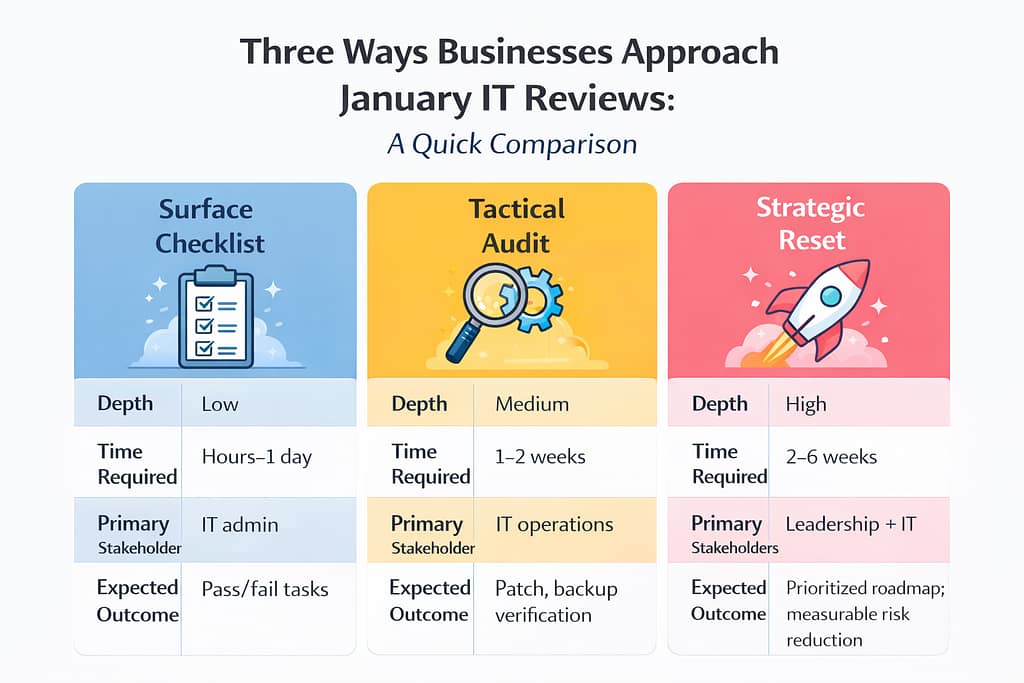
A Quick Comparison: Three Ways Businesses Approach January IT Reviews

Comparison graphic titled “Three Ways Businesses Approach January IT Reviews” showing Surface Checklist (low depth, quick pass/fail tasks), Tactical Audit (medium depth, patch and backup verification), and Strategic Reset (high depth, leadership-driven roadmap and measurable risk reduction), illustrating an IT Reset for businesses.

Most businesses operate in the middle by default.

The organizations that mature fastest intentionally move up the stack—not by doing more, but by deciding better.

A Practical January IT Reset: What to Review (and How to Go Deeper)

Below isn’t a list of tools.
It’s a set of decision areas that determine whether IT supports or silently undermines the business.

Align Technology to the Business Plan

Start by identifying your top three business priorities for the year.

Then map:

  • Which systems support each priority
  • Required performance expectations (SLAs, uptime, response)
  • What failure would cost the business

If a system doesn’t map to a priority, it raises a hard but necessary question:
Why are we funding this?

This is where many organizations uncover shadow spend and legacy tools that survived without justification.

Treat Backups as Recoverability Projects

Backups often give leaders a false sense of security.

Most businesses assume that if data is being backed up, it can be restored quickly when something goes wrong. In reality, many organizations don’t discover gaps until they’re already under pressure—during a ransomware event, a system failure, or an accidental deletion that disrupts operations.

The real question isn’t whether backups exist.
It’s whether your business can actually recover fast enough to avoid downtime, lost revenue, or operational chaos.

That’s why January is the right time to treat backups as a recoverability exercise, not a checkbox.

Calm, structured checklist graphic outlining four January IT Reset for businesses tasks: testing real restores, validating RTO/RPO, assigning a restore owner, and maintaining a clear runbook. Minimal blue icons appear beside each item in a clean, systems‑oriented layout.

The question isn’t “Do we have backups?”
It’s “Can we recover fast enough to avoid real damage?”

Move from Vulnerability Lists to Attack-Path Reduction

Scanning tools generate noise. Attackers exploit pathways.

A stronger January reset focuses on:

  • Identity and privileged access
  • Exposed services
  • Lateral movement opportunities

Breaking attacker chains reduces risk more effectively than chasing every CVE.

This shift requires context, prioritization, and leadership buy-in—not just alerts.

Rationalize SaaS and Licensing Spend

Most organizations underestimate how much budget disappears into unused or overlapping subscriptions.

A January reset should include:

  • Full inventory of SaaS tools
  • Usage vs. cost analysis
  • Consolidation where it reduces complexity
  • Intentional reinvestment of savings
Structured horizontal process graphic illustrating four components of an IT Reset for businesses: SaaS inventory review, usage and cost analysis, tool consolidation, and reinvestment of savings. Uses calm tech-focused icons, restrained blues and greens, and a systematic left‑to‑right flow consistent with InfiNet’s brand aesthetic.

This is often where businesses fund higher-impact security or automation—without increasing total spend.

Rebuild Observability and Runbooks

Alerts without action create fatigue.

Effective systems ensure:

  • Every alert maps to a documented response
  • Clear ownership and escalation paths
  • Tabletop exercises for the top two incident types

When something breaks, the goal isn’t speed alone—it’s clarity under pressure.

Review Vendor and Contract Health

January is the safest time to examine:

  • SLA performance
  • Renewal timelines
  • Exit clauses
  • Vendor risk concentration

Consolidation only makes sense when it reduces risk and friction—not when it’s driven by convenience.

Address People and Skills Gaps

Technology maturity stalls without the right human support.

Rather than trying to fix everything, identify:

  • One critical skills gap
  • One short-term training or advisory investment
  • One clear owner for cross-team coordination

Progress beats perfection—especially early in the year.

Why Many Businesses Struggle to Execute This Alone

None of this is conceptually complex.

What’s hard is:

  • Maintaining objectivity
  • Prioritizing across departments
  • Translating technical findings into business decisions
  • Keeping momentum once Q1 accelerates

This is where many organizations stall—not because they lack tools, but because no one owns the strategic layer.

Where MSP and vCIO Support Changes the Outcome

At its best, MSP support keeps systems stable.

A calm, tech‑forward systems graphic showing interconnected cloud infrastructure, analytics dashboards, review checklists, collaboration elements, and a 90‑day planning cycle. The composition suggests how MSP and vCIO support flow into clearer visibility, structured decisions, and a predictable roadmap.

At its best, vCIO guidance helps leadership:

  • See risk clearly
  • Understand tradeoffs
  • Make intentional technology decisions
  • Align IT spend to business reality

The role isn’t to add complexity—it’s to reduce uncertainty.

A well-run January IT reset creates a 90-day roadmap that:

  • Prioritizes actions by business impact
  • Assigns ownership
  • Reduces exposure early in the year
  • Builds confidence instead of noise

That’s the difference between reacting to issues and running technology with intent.

What “Good” Looks Like Coming Out of January

By the end of a true IT reset, leadership should be able to answer:

  • Where does our biggest risk actually live?
  • Which systems matter most—and why?
  • What are we intentionally not fixing yet?
  • Who owns the next 90 days?

If those answers are clear, the year starts on stable footing.

If they’re vague, the organization is already behind.

Frequently Asked Questions

1. What is an IT reset?

An IT reset is a structured review of systems, risk, and spend that aligns technology decisions to business goals—rather than a simple technical checklist.

2. Why is January the best time to review IT?

January offers fresh budgets, leadership focus, and the opportunity to reduce Q1 risk before issues compound later in the year.

3. How is an IT reset different from an IT audit?

Audits confirm compliance and configuration. An IT reset prioritizes outcomes, tradeoffs, and forward-looking decisions.

4. Do small businesses need a strategic IT reset?

Yes—often more than larger organizations. Smaller teams feel the impact of outages, waste, and misalignment faster and more directly.

5. What role does a vCIO play in an IT reset?

A vCIO provides leadership-level guidance, translating technical findings into business decisions and building a prioritized roadmap.

6. How long should a proper IT reset take?

Typically 2–6 weeks, depending on complexity. The value comes from clarity and prioritization—not speed alone.

A Thoughtful Next Step

If January already feels busy, that’s exactly why clarity matters.

A short, focused conversation can help you understand:

  • Where risk is underestimated
  • Where spend is misaligned
  • What a realistic 90-day plan looks like

That’s how strong years begin. Here’s to a clear, intentional start.

Flat-style illustration of a seated male professional using a digital tablet in an IT operations center. The background shows multiple system monitors and other staff at work. Branding includes the message “Get in touch with our team” and the InfiNet logo.

New Year IT Reset for Businesses: Setting the Year Up Right Read More »

Call Now Button