Why “One Person Doing IT” Becomes a Business Bottleneck
The Hero IT Story Sounds Great… Until It Doesn’t
Every organization has one.
The person who knows where all the passwords are.
The person everyone calls when the printer stops working.
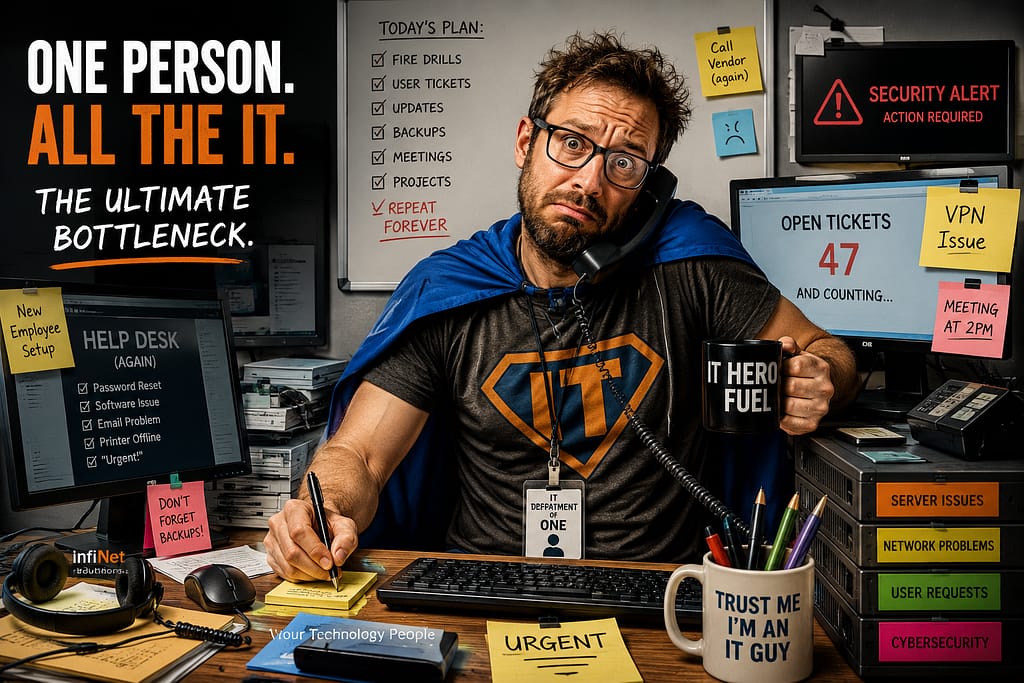
The person who somehow manages Microsoft 365, cybersecurity, backups, vendor calls, internet outages, software updates, new employee setups, conference room technology, and the mysterious issue where Karen’s email “just disappeared.”
They’re the IT hero.
They’re also probably your biggest technology bottleneck.
For many small and mid-sized businesses throughout Omaha, Lincoln, Council Bluffs, and surrounding communities, technology often starts with one capable employee handling everything. Maybe it’s an office manager who became the unofficial IT person. Maybe it’s a technically savvy operations manager. Maybe it’s an internal IT professional wearing fifteen different hats.
At first, it seems efficient.
Then growth happens.
And suddenly, your entire technology environment depends on one person’s availability, knowledge, and sanity.
That’s where problems begin.
The Single-Person IT Trap
Let’s be clear.
This isn’t about criticizing your internal IT person.
In fact, the problem is often the opposite.
They’re usually working incredibly hard.
The issue is that modern business technology has become too complex for one person to effectively manage alone.
Today’s IT responsibilities include:
- Cybersecurity monitoring
- Microsoft 365 administration
- Endpoint protection
- Cloud services
- Backup management
- Compliance requirements
- Vendor relationships
- Network management
- Employee support
- AI governance and adoption
- Disaster recovery planning
- Technology budgeting
- Strategic planning
That’s not one job.
That’s an entire IT department.
Yet many businesses still expect one individual to handle all of it.
What Happens When Everything Flows Through One Person?
Projects Slow Down
Need a new software rollout?
Waiting on IT.
Need cybersecurity improvements?
Waiting on IT.
Need a hardware upgrade?
Waiting on IT.
Need a new employee onboarded?
Waiting on IT.
When one person becomes the gatekeeper for every technology decision, progress naturally slows.
Even the most capable IT professional only gets 24 hours in a day.
(We’ve checked. Microsoft still hasn’t released the “36-Hour Workday” update.)
Critical Knowledge Lives Inside One Brain
This is where things get risky.
Many organizations have undocumented systems, passwords, vendor contacts, and procedures that exist solely in one employee’s memory.
What happens if they:
- Take a vacation?
- Accept another position?
- Get sick?
- Retire?
- Win the lottery and disappear to a tropical island?
Suddenly, your business is scrambling to figure out how systems actually work.
This creates operational risk that most business owners don’t fully recognize until it’s too late.
Cybersecurity Falls Behind
Cyber threats don’t care that your IT person is busy.
Attackers aren’t waiting for your team to catch up.
While your internal IT resource is troubleshooting printers and resetting passwords, critical cybersecurity tasks often get delayed:
- Security monitoring
- Vulnerability management
- Patch management
- User security training
- Incident response planning
- Backup testing
Unfortunately, these are often the very activities that prevent costly ransomware attacks and data breaches.
For businesses across Nebraska and Iowa, cybersecurity is no longer optional. It’s a business necessity.
Technology Becomes Reactive Instead of Strategic
Here’s a question we often ask business leaders:
“When was the last time someone brought you a technology roadmap instead of a technology problem?”
Many organizations with a single IT resource operate in constant firefighting mode.
They’re fixing issues.
They’re responding to tickets.
They’re troubleshooting emergencies.
But who’s planning for the future?
Who’s evaluating:
- AI opportunities?
- Cloud modernization?
- Infrastructure improvements?
- Compliance requirements?
- Business continuity planning?
- Long-term budgeting?
When IT spends all day reacting, innovation takes a back seat.
Growth Exposes the Cracks
A company with 15 employees can often survive with informal technology processes.
A company with 50 employees starts feeling pressure.
A company with 100 employees usually discovers those processes no longer scale.
As organizations grow throughout Omaha, Lincoln, Council Bluffs, Bellevue, Papillion, La Vista, and surrounding communities, technology complexity increases dramatically.
More employees means:
- More devices
- More software
- More security risks
- More support requests
- More compliance requirements
- More integration challenges
The workload doesn’t grow in a straight line.
It compounds.
Eventually, one person simply can’t keep up.
Why Co-Managed IT Is Becoming So Popular
Many businesses assume the only options are:
- Hire more internal IT staff.
- Outsource everything.
But there’s a third option that’s gaining momentum.
Co-managed IT.
This approach allows your internal IT person to remain the trusted face of technology while gaining access to additional expertise, tools, monitoring, cybersecurity resources, and strategic support.
Think of it this way:
Your IT person doesn’t need replacing.
They need reinforcements.
A strong technology partner can help handle:
- 24/7 monitoring
- Help desk overflow
- Cybersecurity management
- Backup oversight
- Compliance guidance
- Strategic planning
- Specialized expertise
Your internal team focuses on business priorities while a broader support team helps carry the load.
Everybody wins.
Especially your overworked IT person.
The Cost of Waiting
Many businesses don’t address IT bottlenecks until something breaks.
A ransomware attack.
A major outage.
A key employee departure.
A failed backup.
A missed compliance requirement.
The reality is that technology bottlenecks rarely announce themselves.
They quietly create inefficiencies, increase risk, and limit growth until the consequences become impossible to ignore.
The question isn’t whether your business depends on technology.
It does.
The question is whether your technology strategy depends too heavily on a single individual.
If the answer is yes, it may be time to build a stronger support structure before that bottleneck becomes a business interruption.
Frequently Asked Questions
Is one IT person enough for a small business?
For very small organizations, sometimes yes. However, as employee counts grow, technology demands often exceed what one person can effectively manage alone.
What are the risks of relying on a single IT employee?
Common risks include knowledge loss, cybersecurity gaps, delayed projects, limited strategic planning, and reduced business continuity if that employee becomes unavailable.
What is co-managed IT?
Co-managed IT combines an organization’s internal IT resource with an external managed services provider (MSP). The MSP provides additional expertise, monitoring, cybersecurity support, and strategic guidance while the internal team maintains day-to-day involvement.
How do I know if my IT team is overloaded?
Warning signs include delayed projects, recurring technology issues, cybersecurity initiatives being postponed, increasing support backlogs, and technology decisions consistently being reactive rather than strategic.
Can an MSP work alongside our internal IT department?
Absolutely. Many businesses throughout Omaha, Lincoln, Council Bluffs, and surrounding areas use co-managed IT services to supplement internal resources rather than replace them.
Don’t Let a Technology Hero Become a Technology Bottleneck
Every business needs reliable technology.
But no business should depend entirely on a single point of failure.
Whether you have an internal IT professional, an accidental IT person, or a team that’s stretched too thin, building a deeper support structure can improve security, reduce risk, and help your business grow with confidence.
At InfiNet Solutions, we’ve spent decades helping organizations throughout Omaha, Council Bluffs, Lincoln, and the surrounding region create technology strategies that scale with their business—not with one person’s workload.
Because even heroes deserve backup.